Buying Guides
How to Choose a Borehole Pump in Kenya

Knowing how to choose a borehole pump matters far more than the horsepower printed on the box. A pump that is too weak never fills the tank, and one that is too strong pulls the borehole dry and cooks itself. This guide is for Kenyan homeowners, farmers and fundis. It covers your driller's report, head and flow, 240V power, dry run protection and the tests to run before ordering.
In this guide
How a Borehole Pump Works and the Types You Will Meet
A borehole pump sits down in the water, not up at the wellhead. Motor and pump body are sealed into a casing slim enough to drop inside the borehole lining, hanging on a rising main with the cable strapped alongside. Because it pushes water up instead of pulling it, suction lift never limits it the way it limits a surface pump.
Inside, water passes through a stack of impellers. Each impeller, or stage, adds a fixed amount of lift, so a pump with more stages reaches higher without a bigger motor. That is why two pumps of the same horsepower can deliver very different heads. The water around the pump also carries heat away from the motor.
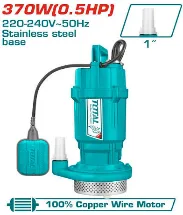
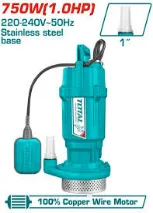
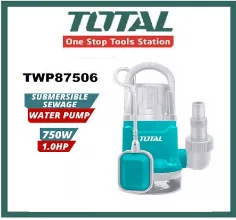
The main types of borehole pump are multistage submersibles, helical rotor pumps, direct current units run off solar panels, and mains units such as the Total Submersible Pump 0.5HP(TWP63706) or the Total Submersible Pump 1.0HP(TWP67506). A drainage machine like the Total Sewage Submersible Pump1.0HP(TWP87506) is built wide to clear a sump, not to fit a casing.
- Multistage submersible: the normal borehole choice
- Solar direct current submersible: pumps into a tank while the sun is up
- Helical rotor: low flow, high lift, slow recovering holes
- Sewage or drainage submersible: sumps only, never boreholes
Start With the Driller's Report, Not the Pump
Every properly drilled borehole comes with a contractor's report, and it holds the numbers that decide the pump. Depths vary enormously. Many holes around Nairobi and the central highlands run between 100 and 200 metres, while others near the coast and the lake basin come in under 100. Depth alone tells you little, since a 150 metre hole may hold water standing 40 metres down.
Three figures matter most. Static water level is where water rests with the pump off. Pumping water level is how far it falls during the test. Tested yield, in cubic metres per hour or litres per second, is the ceiling on everything else. If the hole gives two cubic metres an hour, a pump rated for five only draws the level down to the intake and sucks air.
The report also states the casing diameter, which limits the pump body you can fit.
- Total depth and casing diameter, four or six inch
- Static water level and pumping water level
- Tested yield in cubic metres per hour
- Setting depth: a few metres clear of the sediment
Working Out Head and Flow for Your Site
Two numbers describe what you need, and neither is horsepower. Head is the vertical distance the pump must push water, plus friction lost through pipe, bends and valves. Flow is how much water arrives over time. Every pump has a curve on which flow falls as head rises, so one figure without the other means little.
Work it through on your own plot. Say the pumping level sits 60 metres down, the tank base stands 4 metres above the wellhead, and the tank is on a 6 metre stand. That is 70 metres of static lift, and adding about 10 percent for friction gives roughly 77 metres of head. A 5,000 litre tank filled in three hours needs about 1,700 litres per hour.
Check that flow against the tested yield, because pumping faster than the hole recovers ruins both pump and borehole. If the two land close, size down and run the pump longer rather than harder. Send both figures to ToolHub Kenya on WhatsApp rather than asking for a one horsepower pump.
240V Single Phase Power and What Voltage Dips Do
Most Kenyan homes and farms run on 240V, 50Hz single phase, and on long rural feeders that voltage is not steady. It sags in the evening when everyone switches on, dips when a neighbour's welder or posho mill starts, and can sit low for hours at the tail of a line. When voltage falls, a motor draws more current to do the same work.
That extra current becomes heat in the windings, and heat is what breaks the insulation down and burns a motor out. The drop cable adds its own voltage loss, growing with length, so it must be sized for the full run down the hole. One size too thin can be the whole reason a pump keeps failing. Wiring and earthing are work for a qualified electrician.
Dry Running, Sand and How Long Borehole Pumps Last
Ask any technician what kills more submersibles than anything else and the answer is dry running. Water cools the motor and lubricates the seals. Take it away and the temperature climbs fast, so a pump can be finished before anyone notices the tap has stopped. It happens when the yield was optimistic, when the water table drops through a long dry season, or when a tank float sticks.
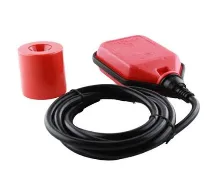
Borehole pump dry run protection takes several forms and any beats none. A low water electrode in the hole cuts the supply when the level reaches it. A flow or pressure switch on the rising main trips when delivery stops, and better control boxes shut down when the current falls, since a dry pump draws less. At the tank end, a float switch such as the Tronic Float Switch stops the pump once the tank is full, ending the overflow and cycling that wear a motor out.
Sand is the slower killer, and it largely decides how long borehole pumps last. Grit grinds at the impellers until the pump moves less water at the same speed, and the first sign is a tank taking longer to fill than last year. Set above the sediment and fed clean water, a pump can work for several years. In a sandy hole it may not see out one dry season.
- Runs but no water: level dropped, blocked intake, split riser
- Flow falling over months: impellers worn by sand
- Trips the breaker: worn bearings, cable fault, low voltage
- Will not start: burnt winding, capacitor or control box
How to Test a Borehole Pump and What to Confirm Before Ordering
Knowing how to test a borehole pump saves a wasted trip back down the hole. Before lowering, an electrician should measure insulation resistance between each winding lead and earth, and check the winding resistances are balanced. The shaft should turn freely by hand. A short run with the pump standing in a drum of water confirms rotation and delivery, but it must never run dry.
Once installed, take real readings. Measure running current against the nameplate, and voltage at the control box while the pump works, not at rest, because that is where a weak supply shows. Time the fill of a tank of known volume for the true flow, then run the pump an hour and watch the drawdown.
- Borehole depth, casing diameter and setting depth
- Static level, pumping level and tested yield
- Total head including tank stand and friction
- Flow needed per hour and tank size
- Power available: 240V mains, solar, or both
- Whether dry run protection and a float switch go in too
Tools mentioned in this guide
Prices change with stock and supplier costs, so we quote on WhatsApp. Send us the tool and your town for today's price and availability.
Frequently asked questions
How does a borehole pump work?
It hangs in the water on the rising main and pushes water up rather than sucking it. Water passes through a stack of impellers, each adding lift, while the water around the unit cools the sealed motor. That is how it lifts from depths no surface pump could reach.
How long do borehole pumps last?
It depends more on the installation and the water than on the pump. Sized correctly, wired properly and protected from dry running in clean water, a pump can work for several years. Sand, low voltage or repeated dry running shortens that sharply.
What are the most common borehole pump problems?
Dry running comes first, then sand wear that slowly cuts the flow, then electrical faults from undersized drop cable or a sagging supply. Others are a split rising main, a blocked intake and a failed starting capacitor.
Do I really need borehole pump dry run protection?
Yes. Water cools the motor, so a pump running in an empty column can be destroyed quickly. A low water probe, a pressure switch, or a tank float switch all prevent it, and any is easier than pulling out a burnt pump.
Can I use a sewage submersible pump in a borehole?
No. A sewage or drainage submersible is built wide to pass solids and clear sumps. It will not fit a borehole casing and is not built for high lift. A borehole needs a slim multistage submersible matched to your depth.