Buying Guides
Circular Saw Buying Guide for Kenyan Carpenters

A circular saw is the fastest way to turn sheets and timber into square, straight pieces, and for most Kenyan carpenters it is the second power tool bought after a drill. This guide covers what really matters when choosing a circular saw in Kenya: blade diameter and the depth of cut it buys you, arbor size, teeth counts on TCT blades, and the handling habits that stop the machine kicking back at you.
In this guide
What to look for in a circular saw in Kenya
A circular saw is defined by the blade it swings. Blade diameter sets the maximum depth of cut, and depth of cut decides whether the saw does the job in one pass. The common workshop size is a 7 1/4 circular saw, cutting a little over 60 mm deep at 90 degrees on most machines. That covers 2 by 4 timber, plywood, MDF and blockboard.
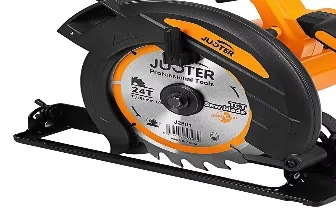
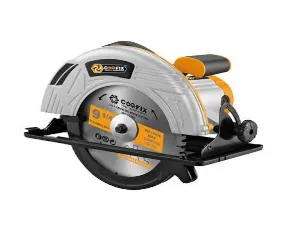
Smaller saws are lighter but run short of depth on anything thicker than a board, while machines taking a 9 1/4 blade cut deeper and weigh more. Motor power matters second, since a stronger motor holds its speed in dense hardwood. The JUSTER Circular Saw 1400W and the COOFIX CIRCULAR SAW 1380W are mains saws of the kind aimed at regular timber work.
Check the depth at 45 degrees as well as at 90. Tilting the base for a bevel costs a surprising amount of depth, often a quarter or more, so a saw that only just manages your timber square will not manage it on the bevel.
- Blade diameter decides maximum depth of cut, so start there
- Check depth at 90 degrees and at 45 degrees before buying
- Match motor power to the hardest timber you actually cut
- Confirm the arbor size before buying any blade
- Look for a flat, solid base plate with no flex or play
Arbor size and fitting a blade correctly
The arbor, or bore, is the hole in the middle of the blade that fits the spindle, and it must match exactly. A blade loose on the spindle will not run true, wanders in the cut and can shatter. Common sizes here are 20 mm, 25.4 mm and 5/8 inch, and some blades ship with a reducer ring.
Every blade carries an arrow showing rotation, and it must point the way the saw turns. A circular saw cuts on the upstroke, the teeth biting up into the underside of the work. Fit a blade backwards and it burns and throws the work. Tighten the arbor bolt properly, remembering it is often reverse threaded.
After you release the trigger the blade coasts for several seconds and is still dangerous. Never set the saw down before it stops and the lower guard snaps closed, and never swing it past your leg while the blade turns.
Teeth count and what 24T, 40T and 60T are for
Teeth count decides how fast and how cleanly a blade cuts. Fewer, bigger teeth clear waste quickly and cut fast but leave a rough edge. More, smaller teeth take a finer bite and leave a clean edge, cutting slower and hotter if you push them.
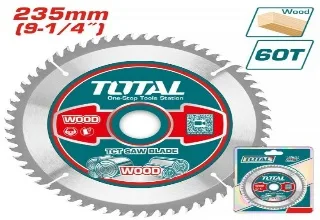
A 24 tooth blade is the ripping blade, for cutting along the grain and rough sizing on site. A 40 tooth blade is the general purpose choice, good across the grain and acceptable in plywood. A 60 tooth blade, such as the TCT SAW BLADE 9-1/4 (60T).TAC231623 for saws taking that diameter, is the fine finishing blade for melamine faced board and MDF.
TCT means tungsten carbide tipped. Each tooth carries a brazed carbide tip that stays sharp far longer than plain steel in board products, which blunt edges fast because of their glue and resin. Give ToolHub Kenya your blade diameter and arbor size on WhatsApp rather than buying on diameter alone; a blade such as the SAW BLADE TAC51144D must be matched to the saw.
- 24T: ripping along the grain and fast rough sizing
- 40T: general purpose crosscutting and plywood
- 60T and finer: melamine, MDF, trim and visible finish cuts
- TCT tipped: essential for board products that blunt plain steel
Setting the depth of cut every time
Setting the circular saw depth of cut is a habit, not a one-time adjustment. Release the depth lever, sit the shoe on the work with the blade beside it, and set the blade to project just past the underside, roughly one tooth or 3 to 5 mm. Lock the lever before switching on.
Running the blade just through the work does three things. Less blade is exposed underneath, so there is less to catch your hand or the trestle. Fewer teeth are engaged, which lowers the load on the motor and the risk of binding. The cut is cleaner, because the teeth slice steeply through the fibres.
Kickback, riving knives and supporting the work
Kickback is what happens when the blade binds and the saw, unable to drive the blade through the timber, drives itself backwards at you. The usual causes are the kerf closing as the timber relaxes, the offcut sagging and pinching, twisting the saw off the line, or forcing it too fast.
The riving knife, the thin plate behind the blade, prevents that by holding the kerf open, so never remove it or bend it out of line. The lower guard should snap shut the instant the blade leaves the work, so clean resin off it rather than tying it back. Hold the saw with both hands, stand to one side of the line, and let the blade reach full speed first.
Support prevents most bad cuts. Never bridge a board between two trestles and cut in the middle, because both halves sag inwards and pinch the blade. Support the full width from underneath on sacrificial timber so the offcut cannot drop and twist. Never hold a small offcut by hand or cut a loose piece freehand; clamp the work and run the shoe along a clamped batten or guide rail.
Which face goes up, and site power
A circular saw cuts upwards through the underside, so the face against the shoe stays cleanest and the tearout appears below. Cut timber and plywood face up when the top face will show. On melamine or veneer, lay the face that matters uppermost, fit a fine TCT blade and score the line with a knife first.
Mains saws run on the 240 V, 50 Hz single-phase supply and give sustained power for a full day of sheet work. The catch on site is the extension lead, because a long thin lead drops voltage and the motor then runs hot and loses power. Use a heavy gauge lead, keep it short and unroll it fully.
A cordless circular saw earns its place on roofs, scaffolds and first fix work where dragging a cable is the slow part. Sheet ripping empties packs quickly, so plan on two batteries and a charger. Wear eye protection, add a dust mask for MDF, and unplug the saw or remove the battery before changing a blade.
When a mitre saw or jigsaw is the better tool
A circular saw is a straight line machine. For repeated accurate crosscuts on timber, skirting, roof members or beading, a mitre saw is faster, safer and more accurate, because the work sits against a fence and the blade comes down on a fixed path. If your day is mostly cutting lengths to size, buy the mitre saw.
For curves, circles, keyhole cuts and sink cutouts, use a jigsaw. Steering a circular saw around a curve is a classic cause of kickback and a ruined blade. For a hole in the middle of a panel, a jigsaw started in a drilled hole is safer than plunging a circular saw.
If you are building the kit one tool at a time, a corded circular saw with a good general purpose TCT blade covers the widest ground first. Message ToolHub Kenya on WhatsApp with the blade diameter and arbor size of your saw and we will confirm which blades match. Delivery across Kenya is available.
Tools mentioned in this guide
Prices change with stock and supplier costs, so we quote on WhatsApp. Send us the tool and your town for today's price and availability.
Frequently asked questions
What circular saw depth of cut do I actually need?
Work back from your thickest common material. A 7 1/4 circular saw typically cuts a little over 60 mm at 90 degrees, handling 2 by 4 timber, plywood and blockboard in one pass. Check the 45 degree figure too, since bevelling loses much of that depth.
Which TCT blade teeth count should I buy first?
If you keep only one, a 40 tooth TCT blade is the best general purpose choice, cutting acceptably along and across the grain and in plywood. Add a 24 tooth for fast ripping and a 60 tooth or finer for melamine and MDF.
Will any circular saw blade fit my power saw?
No. The diameter must suit the saw and the arbor hole must match the spindle exactly. A blade that is too large will not fit the guard, and one with the wrong bore will run out of true or shatter. Take the old blade with you.
Is a cordless circular saw good enough for a full working day?
For roofing, first fix and site trimming a brushless cordless saw does real work and saves time on cables. For a day of ripping sheets you need at least two batteries and a charger. Battery saws also tend to have less depth of cut.
Which side of the board should face up when I cut?
A circular saw cuts upwards, so the underside chips and the top face stays cleanest. Lay the board with the face that will show uppermost, fit a fine TCT blade on melamine, and score the line before cutting.
What causes kickback and how do I avoid it?
Kickback comes from the blade binding, usually when the kerf closes, the offcut sags and pinches, or the saw is twisted off the line. Keep the riving knife fitted, support the work across its full width, set the depth correctly, and never force the saw.